Because all women are thinking women, we are here to provide them with food for thought.
Sunday, July 19, 2009
Walter Cronkite: In Memorium

Wednesday, January 30, 2008
Clinton or Obama?
While we’d happily vote for whichever candidate gets the nomination, we are facing a Super Tuesday with an unprecedented opportunity – a chance to vote for a female or African-American nominee. As our hero Jon Stewart pointed out, 100 years ago in this country, neither one would have been able to run – or vote!
So how to decide? Here are two excellent arguments by intelligent, informed supporters of each candidate. We hope that reading them will help you decide. Let the debate begin.
THE ARGUMENT FOR HILLARY
I am a big supporter of Hillary Clinton. I think that the biggest argument against her seems to be that she is married to Bill Clinton, and that she has been around in politics longer than Obama. My problem with Obama is that he hasn't done much politically. I don't doubt that he is more than capable intellectually for the job, so I feel that the country will be in better hands with either Democrat, since it appears to be a two-way race.
But I like so many things about Hillary Clinton. I think she's extremely smart, she is from a working class family, and has been living the American
Dream. She is a woman who has been a successful working mother, and has made the extremely difficult choice of remaining in a marriage with someone whose behavior has been scrutinized and criticized, and her choices criticized.
She successfully won re-election to the Senate, and understands politics.
In addition, she is well respected, and personally known, internationally. I think that the president's primary job is going to be restoring friendships internationally. Hillary already knows a percentage of the politicians, and in most countries, a woman in a position of leadership is less controversial than here. The only place it will be a problem will be in the Middle Eastern countries. But if she restores the support of the majority of the world, that will be less of an issue.
THE ARGUMENT FOR BARACK
You now have to decide whom, between the two remaining contenders for the Democratic nomination in August, you want to support. For me the decision is a simple one. It is simple because among the two remaining contenders one is a Corporate Democrat while the other is simply a Democrat.
Hillary Clinton is a corporate attorney. She sat on the Board of Directors of Wal-Mart while that company was paying subsistence wages, creating miserable working conditions and firing workers who tried to organize into trade unions in order to better their lot. She is the politician who has received more money from the pharmaceutical industry than any other. Her only child learned well from her mom -- she's now a hedge-fund manager.
Barak Obama is a much better choice to lead us into the future. He has often spoken critically of corporate greed and comes from humble beginnings making him much more likely to mistrust, monitor, and restrain the moneyed power elite for the welfare of ordinary Americans. Mr. Obama's policies on universal single-payer health insurance, ending our involvement in the war in Iraq, care for returning Iraq war veterans -- nay, all veterans, the environment, education, etc. are very similar to John Edwards' policies. We can proudly stand behind Barak Obama.
Wednesday, November 08, 2006
The Truth About Partial Birth Abortion
The only problem is that this gruesome picture, like most stories designed to shock and scare, only retains a tiny fragment of the truth.
This procedure is properly called a D&E or dilation and extraction or a D&X, an “intact” D&E. It is this latter procedure that causes nightmares. It is extremely rare and seldom performed when a D&E is possible. In all cases, the procedure is performed in the second trimester of pregnancy before the baby is viable and only when the mother’s health is severely threatened or the fetus is severely deformed.
Although a D&E accounts for only 10 percent of abortions, the women we know who needed one had no other choice. In two cases, the fetus died in utero. You can only imagine how emotionally devastating this sort of thing can be. In both cases the mother went to the obstetrician’s office for a routine check-up and was told that there was no heart beat. The heartbreak of loosing a potential child was compounded by the fact that somehow the lost fetus needed to be extracted. When it came time to choose between hours of labor and its potential risks with no baby to hold at the end and a medical procedure they could sleep through, they chose the latter so as not to prolong the nightmare.
In another case, the mother learned that the child she carried was severely deformed and without most of its brain. Even if she carried this fetus to term, it would only survive a matter of hours and the deformities would cause an exceptionally difficult delivery. The woman and her husband chose a D&E instead, even though they found this choice so emotionally devastating it eventually ended their marriage.
This is the picture that is obscured when well-meaning but ignorant lawmakers climb upon their soapboxes to assure their constituency that they are indeed champions of the weak and defenseless. Sadly, suffering women are seldom included in those numbers.
Jewish teachings hold the life of the mother as paramount in these situations. Since this is the origin of our nation's Judeo-Christian tradition, can we at least hope that the Supreme Courst will consider this when deciding the case? Although we are missing Justice Sandra Day O'Connor and her moderate and experienced views on the subject, perhaps this time the court will listen to unbiased and expert testimony that will shine a clearer light on this dark and frightening necessity.
Doing What Donkeys Do Best

"You’re the ones who made this bed. Now you’re the ones who are going to have to move over so a gay couple can sleep in it. Tomorrow you’re all going to wake up in a brave new world. A world where the constitution gets trampled by an army of terrorist clones created in a stem-cell research lab run by homosexual doctors who sterilize their instruments over burning flags. Where tax & spend Democrats take all your hard-earned money and use it to buy electric cars for National Public Radio and teach evolution to illegal immigrants. Oh – and everybody’s high!"
-- Stephen Colbert
Okay, we admit it. We’re a teeny bit high today. Not on drugs, but on the idea that the orderly transition of a government by the people, of the people, and for the people has not perished from this earth.
Oh, yeah, and we like the fact that the Democratic donkey did what donkeys do best: kicking.
We have to admit that as Democrats, we are not given to premature pronouncements or even the kind of self-empowered optimism found among members of other political parties. It wasn’t until the crawl along the bottom of our television screens started mounting up Democratic victories that we allowed ourselves to believe that what the pundits predicted would actually happen.
And even now, we fret a bit. Will Congress become even further to the right with the exit of moderate Republicans and the entrance of centrist Democrats? Can a Democrat capture the White House if there’s a Democratic majority in Congress? Will the Democrats really focus on doing what's good for the country, and not indulge in revenge politics?

One thing is certain – the brutality of the war in Iraq and the flagrant misbehavior by GOP office holders has worn the people down. And the Democrats have kicked the bums out.
Only time will tell if this is a good thing. But right now, riding on the wave of optimism that comes with the balance of powers in action, we look forward with the expectation that President Bush will finally live up to his 2000 campaign promise, that he is a uniter, not a divider.
Thursday, August 24, 2006
Beyond Fight or Flight: Why Women's Friendships Work
That is why we want to share with you something that has recently come to our attention. A UCLA study of women's responses under stress suggest that women use friendships with other women and tending to others to deal with life's stressors, beyond the traditionally accepted "fight or flight."
Clicking the header will bring you directly to the study, but we think Gale Berkowitz did such a nifty job of summing it all up, that what follows is her analysis, found in the Utne Reader and at anapsis.org, among other places. We think you will agree that, more than just food for thought, this is affirming and enobling for women:
UCLA Study On Friendship Among Women
An alternative to fight or flight
©2002 Gale Berkowitz
A landmark UCLA study suggests friendships between women are special. They shape who we are and who we are yet to be. They soothe our tumultuous inner world, fill the emotional gaps in our marriage, and help us remember

who we really are. By the way, they may do even more.Scientists now suspect that hanging out with our friends can actually counteract the kind of stomach-quivering stress most of us experience on a daily basis. A landmark UCLA study suggests that women respond to stress with a cascade of brain chemicals that cause us to make and maintain friendships with other women. It's a stunning find that has turned five decades of stress research---most of it on men---upside down. Until this study was published, scientists generally believed that when people experience stress, they trigger a hormonal cascade that

revs the body to either stand and fight or flee as fast as possible, explains Laura Cousin Klein, Ph.D., now an Assistant Professor of Biobehavioral Health at Penn State University and one of the study's authors. It's an ancient survival mechanism left over from the time we were chased across the planet by saber-toothed tigers.Now the researchers suspect that women have a larger behavioral repertoire than just fight or flight; In fact, says Dr. Klein, it seems that when the hormone oxytocin is release as part of the stress responses in a woman, it buffers the fight or flight response and encourages her to tend children and gather with other women instead. When she actually engages in this tending or befriending, studies suggest that more oxytocin is released, which further counters stress and produces a calming effect. This calming response does not occur in men, says Dr. Klein, because testosterone---which men produce in high levels when they're under stress---seems to reduce the effects of oxytocin. Estrogen, she adds, seems to enhance it.
The discovery that women respond to stress differently than men was made in a classic "aha" moment shared by two women scientists who were talking one day in a lab at UCLA. Th

ere was this joke that when the women who worked in the lab were stressed, they came in, cleaned the lab, had coffee, and bonded, says Dr. Klein. When the men were stressed, they holed up somewhere on their own. I commented one day to fellow researcher Shelley Taylor that nearly 90% of the stress research is on males. I showed her the data from my lab, and the two of us knew instantly that we were onto something.The women cleared their schedules and started meeting with one scientist after another from various research specialties. Very quickly, Drs. Klein and Taylor discovered that by not including women in stress research, scientists had made a huge mistake: The fact that women respond to stress differently than men has significant implications for our health.

It may take some time for new studies to reveal all the ways that oxytocin encourages us to care for children and hang out with other women, but the "tend and befriend" notion developed by Drs. Klein and Taylor may explain why women consistently outlive men. Study after study has found that social ties reduce our risk of disease by lowering blood pressure, heart rate, and cholesterol. There's no doubt, says Dr. Klein, that friends are helping us live longer.In one study, for example, researchers found that people who had no friends increased their risk of death over a 6-month period. In another study, those who had the most friends over a 9-year period cut their risk of death by more than 60%.
Friends are also helping us live better. The famed Nurses' Health Study from Harvard Medical School found that the more friends women had, the less likely they were to develop physical impairments as they aged, and the more likely they were to be leading a joyful life. In fact, the results were so significant, the researchers concluded, that not having close friends or confidants was as detrimental to your health as smoking or carrying extra weight.
And that's not all. When the researchers looked at how well the women functioned after the death of

their spouse, they found that even in the face of this biggest stressor of all, those women who had a close friend and confidante were more likely to survive the experience without any new physical impairments or permanent loss of vitality. Those without friends were not always so fortunate. Yet if friends counter the stress that seems to swallow up so much of our life these days, if they keep us healthy and even add years to our life, why is it so hard to find time to be with them? That's a question that also troubles researcher Ruthellen Josselson, Ph.D., co-author of Best Friends: The Pleasures and Perils of Girls' and Women's Friendships (Three Rivers Press, 1998). The following paragraph is, in my opinion, very, very true and something all women should be aware of and NOT put our female friends on the back burners.Every time we get overly busy with work and family, the first thing we do is let go of friendships with other women, explains Dr. Josselson. We push the m right to the back burner. That's really a mistake because women are such a source of strength to each other. We nurture one another. And we need to have unpressured space in which we can do the special kind of talk that women do when they're with other women. It's a very healing experience.

Taylor, S. E., Klein, L.C., Lewis, B. P., Gruenewald, T. L., Gurung, R. A. R., & Updegraff, J. A. Female Responses to Stress: Tend and Befriend, Not Fight or Flight" Psychol Rev, 107(3):41-429.
Geary DC, Flinn MV. Sex differences in behavioral and hormonal response to social threat: commentary on Taylor et al. Psychol Rev 2002 Oct;109(4):745-50; discussion 751-3
Cousino Klein L, Corwin EJ. Seeing the unexpected: how sex differences in stress responses may provide a new perspective on the manifestation of psychiatric disorders. Curr Psychiatry Rep. 2002 Dec;4(6):441-8.
Thursday, August 17, 2006
Happy Feet

We have a confession to make. Those of us who have grown up to be thinking women started out as thinking girls who loved to put Broadway albums on the hi-fi (yes, kids, this was in the days before CDs, cassettes, and even stereos), dress up in mom’s old evening dresses and dance. It didn’t even matter whether we had seen the musicals, all that mattered was the dancing.
Later, we got to know the real thing through high school drama clubs, regional performances and late-night babysitting viewings of those dashing hoofers who leaped and twirled in old MGM musicals. Let's face it: it was impossible not to have a crush on Gene Kelly.
It gives us real pleasure when the things we loved as kids and thought were gone forever, return. So we are tickled pink to see the renewed interest in dance, thanks, in large part, to the Brits. First came ABC's smash success last summer, "Dancing With The Stars," which pairs celebrities with professional ballroom dancers, and shows us the process of training a non-dancer to compete with the pros.
Then, the brilliant Nigel Lythgoe took the formula he developed back home in England, and brought it to America, first as "American Idol," and then this summer's hit, "So You Think You Can Dance."
In a blockbuster finale, the winner of "So You Think You Can Dance" was a young man from California named Benji
Schwimmer. His lively personality, lovable goofiness and awesome dancing talent won him the hearts of America and gave Fox the highest rated program this summer.But it wasn’t just young Benji – who reminds us of another Benji we know – who dazzled America. He was accompanied by nine other young dancers who reminded the nation of the athleticism, poetry and excitement of the art form. As they tackled everything from hip-hop to Viennese waltz to Broadway with stops in between for salsa, contemporary and swing, the young dancers reawakened interest in moving to the beat.
The outcome has been phenomenal. Programs that feature dancing are proliferating. "Dancing With The Stars" starts its third season in a couple of weeks, and hopes to repeat last year’s ratings. A new movie about a street dancer and a ballerina opened big at the box office last weekend. And the recently announced national tour of the top ten contestants on "So You Think You Can Dance" sold out in 11 minutes in New York.
Can a renewed appreciation of such classics as "Top Hat" and "An American in Paris" be far behind? We can only hope that a new generation will appreciate Gene Kelly tap dancing on roller skates, Fred Astaire dancing on the ceiling, or the legendary Bill Robinson showing Shirley Temple how it’s done.All of this does more than give us pleasure. It makes us feel like putting on our dancing shoes.
Dancing, anyone?
Saturday, August 05, 2006
Stop the Insanity
September 11, 2001 was one of these days. We weren’t around then, but we have every confidence that Dec. 7, 1941 – the bombing of Pearl Harbor – was one of those days as well.
Madness, psychology experts tell us, is a state induced by unpredictable negative stimuli. Predictable negative stimuli may make us neurotic but we’re equipped to handle it. The unpredictable type can bring on schizophrenia, psychosis, borderline personality disorder and politicians.
So is it any wonder that recent events have made things feel nuts? One day all is calm, the next some state-sponsored terrorists provoke a violent response from the Middle East’s only democracy. We have innocents being bombed in Lebanon to go with those under attack in Iraq and Afghanistan. A Jewish community center becomes the focus of rage. And conservative TV pundits decide to add to the mayhem by declaring that we are in World War III.
Are they Chicken Littles or just big chickens?
One of the favorite betting events in the Judeo-Christian tradition is trying to predict when Armageddon will arrive – even though we’re told quite explicitly that this is a no-no. Recent events have sparked landmark business in this proud tradition. Everyone from evangelical fundamentalists to the Lubavitcher Hasidim have added their “evidence” to the party. All of this adds to what used to be free-floating anxiety but now resembles a strafing run on sanity.
We at the Thinking Woman think we need to have a mother (or The Mother/Father) put a foot down and send someone to his room without dinner. It’s time to realize that we have a choice: We can take the path of love by serving the poor and distressed, truly living every day in expectation of the coming of the Messiah. Or we can take the path of fear and produce a bloody apocalypse as it is written, not in the Bible but in the national best-selling Armageddon novels.
All this focus on when it will happen and how effectively diverts people from our primary responsibility -- stewardship and service. Perhaps the world will end next week, perhaps next month, perhaps not for centuries. The signs have been interpreted as such in past centuries. But we cannot stop loving and caring for the world we were given. God, when he gave stewardship of the earth to man, didn't say that we could stop when we thought the end was near. Civilizations have been destroyed before, and the end did not come.
We must, like our forebearers, live our lives in the expectation of the coming of the Messiah, but not use it as an excuse to be irresponsible and selfish.
Like any family, we can choose to work together, heal ourselves and our world and end this madness. Then we can let everyone out of their rooms so we may all finally sit together at the same table as family. Or we can go forward with violence, horror and madness.
The choice is ours.
Wednesday, March 08, 2006
Farewell Too Soon
Dana Reeve, 44, succumbed Monday to lung cancer. (Note: she was a non-smoker; lung cancer is more prevelant in non-smoking women than men.)
A talented singer, actor, motivational speaker and devoted mother, Ms. Reeve made her biggest impact after her husband, actor Christopher Reeve, was paralyzed by a spinal cord injury. She cared for him and fought by his side to put the possibility and hope into finding treatments for spinal cord injuries. Together they founded the Christopher Reeve Foundation, an organization she chaired after her husband's death. We like to think that she was the Superwoman behind Superman.In an official statement from the foundation, spokeswoman Maggie Goldberg noted, "Ms. Reeve established the Foundation's Quality of Life initiatives: the Quality of Life grants program and the Christopher & Dana Reeve Paralysis Resource Center. Since its inception in 1999, the Quality of Life grants program has awarded more than $8 million to support programs and projects that improve the daily lives of people living with paralysis."
Dana Reeve's grace and passion inspired us and never stopped moving us. And, like Elizabeth Glazer in her battle against AIDS, Dana Reeve never stopped hoping, believing, and fighting, throughout her battle with cancer. She set the bar high for women, and we have to wonder. Are we up to the challenge?
With her on that bus is the most beloved player in baseball, Kirby Puckett, 45, who suffered a stroke on Sunday and passed away on Monday. Although the past ten years since his forced retirement from sudden onset glaucoma have reminded us that our heroes are mere mortals, Kirby Puckett gave us a reason again to love baseball.

And America loved him for it. How much? Consider this: In 1982, the year the Minnesota Twins picked Kirby Puckett in the amateur draft, the name "Kirby" dropped off the chart of male baby names (a list compiled by the Social Security Administration). The year after the Twins won the 1987 World Series, "Kirby" jumped almost 200 places on the list of male baby names from No. 867 to No. 684. In 1996, when Puckett left baseball, the name "Kirby" dropped to No. 970 on the list of top 1,000 male baby names. The next year it disappeared. (To read more, check out Minneapolis Star Tribune columnist Nick Coleman's commentary on Kirby.)
Kirby Puckett modeled everything that is good in baseball. He not only played with excellence, he
worked the hardest and the longest. He was the first one at practice, and gave it his all, even in a meaningless exhibition game. In the clubhouse, he was the first one to welcome the new guy. He always had time for the fans, especially kids. And his puckish smile and joy for the game infected everyone around him. His unique batting stance was copied on playgrounds across the country. He was the guy the other ballplayers, teammate or opponent, always wanted to be near. He, too, set the bar high -- for excellence in sports.Our world shines a little dimmer today with their absence from our midst. But, oh, how brightly that bus must be shining. And the others on the bus are crowding around Kirby and Dana, wanting to bask in their light.
Tuesday, February 28, 2006
A Double Deputy Farewell
an interesting sense of humor. Remember when Mother Teresa died the same weekend as Princess Diana? What could they possibly have had to talk about? Do you think they discussed charity work or do you think Diana asked the nun how she stayed so thin?This weekend the pairing was ironic once again: Dennis Weaver and Don Knotts. Both actors became famous on television for portraying deputies, although in different eras and locations. Don Knotts, as anyone who didn’t spend the 20th century in cave knows, played the bulbous-eyed and perpetually anxious Deputy Barney Fife on "The Andy Griffith Show." Dennis Weaver got his start on "Gunsmoke," playing the slow-talking and slow-moving sidekick Chester to James Arness’s towering sheriff.
Both actors appeared in dozens of other successful projects. Knotts was beloved for his grace and generosity with his fellow actors and his fearless embrace of the most distasteful of characters. He was a master comic always happy to play the foil to a more handsome and appealing leading
man.Don Knotts, it's also good to note, was a big screen star. Among his popular films were "The Incred
ible Mr. Limpet" (where he turns into a fish), "The Reluctant Astronaut" and "The Ghost and Mr. Chicken." His friendship with Andy Griffith extended back to when they were in “No Time for Sergeants” on Broadway. Andy also convinced producers to cast him in the film version.Dennis Weaver, blessed with far better looks than Knotts, was promoted to sheriff on the series "McCloud." A lifelong environmentalist, Weaver often chose projects that reflected his love of nature and the outdoors. He was also one of those rare actors who remained married to the same woman for 61 years.
It’s hard to realize that these actors, who were fixtures of our childhoods, are unknown to our own children. With their passing goes another piece of our youth and an indelible reminder that each generation gives way to the next. We just hope that with the appalling lack of quality fare on television these days, someone new will step up to fill in their boots. There doesn’t seem to be many actors today who, like Knotts and Weaver, are as admirable off screen as they are on.
We’re glad that they both have someone great to talk to on that bus ride.
Rabbi Marc Gellman of God Squad fame takes a look at some of the television icons we lost recently – Scotty, Gilligan and Barney Fife -- in this column from Newsweek.
Wednesday, January 11, 2006
Top 10 Men We Loved in 2005
The wax has been scraped off the menorah. The ornaments have been carefully taken off the tree and put where the dog can’t eat them. The brownies from Grandma Dee have been reduced to crumbs. The holidays are over and we can hardly remember what all the stress was about.
Well, maybe we remember a little since the thinking women have been thinking guiltily about their absence from leading their sistren through the often arcane and labyrinthine world of the media, politics and current events. But dammit, we’ve got laundry to catch up on, don’t you?
To smooth over our negligence, we offer this, our distaff version of the old Esquire Magazine “Women We Love” annual. For your reading pleasure – and ours until we can get back in the saddle – here are:
Top Ten Men We Loved in 2005 and Why.
1. Jon Stewart. He can make you laugh while eviscerating a politician with such intelligence and skill that you never see it coming. His “fake” news program proves that the smartest guy in the kingdom is still the jester. And now he’s hosting the Oscars. Hooray!2. Steve Martin. He was finally honored with the Mark Twain Prize for Comedy by the
Kennedy Center. What took them so long? He has been making us laugh with his gentle, silly and sarcastic form of comedy since before even his hair was gray. He’s fast becoming a favorite novelist as well, shedding a gentle, humorous light on difficult lives. Besides, he gives us happy feet. 
3. Ted Koppel. A consummate man of class, Koppel left Nightline with the same dignity and unflinching candor as when he began. We’re just glad he was there to see us through the hard times.
4. Stephe
n Colbert. Can those eyebrows go any higher? He may have started out slowly, but the Colbert Report has been gaining steam as Colbert becomes the flip side of Jon Stewart’s befuddled everyman. Besides, he coined the 2005 Word of The Year, "truthiness."5. U.S. Sen. Charles Schumer, (D-NY). Call him arrogant, call him self-serving, call him
liberal – Chuck doesn’t care. He’s still there on the front lines making sure that the best interests of the people are served. Let other politicians compromise their progressive values, we know that Schumer will stand firm.6. Mark Harmon. He's Mark Harmon, isn't that enough? But in case it's not...In a time when youth rules on television, he is the center of one of the coolest shows on television, "NCIS." He has the looks of a leading man combined with the versatility, dependability and generosity found in the great character actors. And he doesn't appear to know it. Who can resist that?
7. Al Franken. The Left was fair game for the Right’s media darlings until Big Al stepped i
nto the fray. His hilarious, scathing and well researched books gave opposing pundits such as Bill O’Reilly fits. Then he gave birth to an always entertaining and informative radio show, as well as an entire radio station devoted to progressive viewpoints. And he’s no paper tiger. He supports the troops not only in words, but by taking regular USO trips to entertain them.
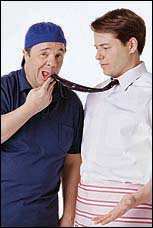
8. Matthew Broderick and Nathan Lane. Broadway’s cutest couple. By themselves they are accomplished and acclaimed performers. But, together, their chemistry is so potent that they are the new acting dynasty. (Thank you, Mel Brooks!) In 2005, with a sold-out run of "The Odd Couple" on Broadway and the release of the film version of their smash stage musical, "The Producers," it is hard to remember a time when they acted alone. (Sorry, Sarah Jessica!)
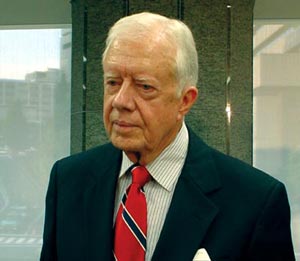
9. Jimmy Carter. Whatever you may have thought of him as president,
there’s no doubt in our minds that he is the greatest former president of this, or any, century. Well into his 80s, he continues to make a significant difference in the world while writing books and building homes in his spare time. He is often the voice of sanity in a world gone mad, reminding us that a good Christian loves all his fellow man and works to ease the burden of the oppressed. All this, and he truly loves his wife, an increasingly rare phenomenon in public life.
10. Herb and Glenn. One is a father and another a husband, but the men in our lives who are
there for us certainly qualify. These are the kind of men who would drive through a blizzard to pick you up from an airport, think of you whenever something you both love comes on the television and lose their right hand before they would let you down in the ways that truly matter. (And this doesn't even touch on their personal accomplishments.) They are the men behind the thinking women and it’s time they got a moment in the spotlight. Our only hope, here at The Thinking Woman, is that you have men like these in your life, too.
Monday, July 18, 2005
The Incredibles vs The Fantastic Four
The first three heroes have been well portrayed in the movies. Superman I, Spider-Man 2 and Batman Begins nailed just what makes these heroes the icons they have become. Now there is a movie about the archetypal super family. It explores what makes a family, how the interaction between the parental figures sets the standard for the entire family’s health and well-being, and the gee-whiz wonder of having super powers.
The name of this movie is The Incredibles.
Unfortunately, the eponymous movie about the Fantastic Four does not explore any of these themes. Instead, it is bogged down in minute details and sacrifices everything, even story telling. The movie is called the Fantastic FOUR and yet at no time did I feel that we had four fantastic individuals or even one fantastic family.
Instead, we had Michael Chiklis in heavy latex darkly lamenting his fate as the ugly and brutish Thing. When the love of his life runs off in the middle of a Brooklyn Bridge crowd just as he’s saving an engine full of firefighters from plunging off the side, I felt not pity but amazement at the stupidity of the director. The unreality of a woman dumping a man in the middle of a heroic rescue before TV cameras – by leaving his engagement ring on the blacktop no less – outweighed the unreality of a man lifting a truck.
As a foil to the Thing we have the Human Torch who is so full of zippy, fun adventures that he seems to be in a different movie. So what if he catches on fire in the middle of an extreme skiing adventure? Instant hot tub for Torchy and the babe du jour. In addition, he’s pulling shaving cream pranks on the Thing – who we witness in a previous scene as being barely able to feed himself.
At least these two “children” have personalities. The parental figures, Mr. Fantastic aka Dr. Reed Richards and Susan Storm aka the Invisible Woman, aren’t much more than attractive forms for skin-tight body suits. We are told that Sue is a doctor of genetics, but she does little beyond play mother hen and defer to her genius boyfriend. She has the power to contain a supernova (a supernova!) with her invisible force field – and yet she can’t keep the bad guy from punching her in the face. The only emotion she stirred in the audience the night I saw it was nervous giggles – it seems that the woman could become invisible by bending light waves but somehow failed to make her clothing disappear. What should she do? Why strip in a crowded public street, of course!
Equaling her in bland fussiness is Reed. Rather than being a bold leader with an incisive mind as in the comics, this Reed is just a science geek who can’t seem to succeed at anything. He hems and haws, he dithers and dallies. Through most of the movie he acts like an extra from the research department who was standing in for the star during lighting rehearsals. And he had so little romantic chemistry with the lovely Sue, he couldn’t even make my 10-year-old son squirm at the “mushy stuff.”
The Fantastic Four should be about what holds a family together and what tears it apart. That was the essential theme in the original comic books that made them so compelling. And that is what made The Incredibles, well, incredible. By the end of The Incredibles, we were uplifted at the prospect of what a group of related individuals could accomplish through acceptance, teamwork and a mutual celebration of their individual abilities.
It’s a sad day when the homage to the icon does it better than the original.
Tuesday, June 07, 2005
The Old Double Standard Still Thrives
Recently we were a bit shocked to learn that Medicaid was paying for Viagra for sex offenders, while little or no effort is made to develop effective birth control for women, which shows us that the double standard is alive and well.
Katha Pollitt, in the The Nation, provides thought-provoking insight. Read her commentary here:
http://seattlepi.nwsource.com/opinion/227076_focus05.html
Friday, May 06, 2005
The "secret Downing Street memo"
We find particularly disturbing the second paragraph, which we quote here:
"C reported on his recent talks in Washington. There was a perceptible shift in attitude. Military action was now seen as inevitable. Bush wanted to remove Saddam, through military action, justified by the conjunction of terrorism and WMD. But the intelligence and facts were being fixed around the policy. The NSC had no patience with the UN route, and no enthusiasm for publishing material on the Iraqi regime's record. There was little discussion in Washington of the aftermath after military action."
Here is the link to The [London] Times's publication of the entire memo: http://www.timesonline.co.uk/article/0,,2087-1593607,00.html
Wednesday, March 09, 2005
We should all be this lucky
"They were soul mates, and they were linked at the heart," says their daughter, Linda Putnam. "They could just never be apart."
They were 95, and Ted went first. Went ahead, that is. The family says Ted would want to be sure everything was ready before Fern came along.
This is a beautiful story about a married couple who were soulmates. Nick Coleman, columnist for the Minneapolis Star-Tribune, has written a wonderful tribute to the first chairman of the Physics Department at Augsburg College in Minneapolis, and his wife. Embedded is a reminder that science and a strong faith do not have to be mutually exclusive. Please take the time to read this touching story: http://startribune.com/stories/357/5281377.html
Saturday, February 19, 2005
Freedom of the Press?
There are several disturbing things about this:
1. A person with close ties to the Republican Party was allowed in to ask highly biased questions, some of which were derived from statements made by Rush Limbaugh on his radio program that were not independently verified before "Jeff Gannon" stated them as fact.
2. That a person with an assumed name could get himself admitted to the White House, close to the president and his staff. Since we assume that anyone entering the closely-guarded White House is checked out pretty thoroughly before being allowed to enter in any capacity, how could there be such a security lapse? And repeatedly? No one found out he was not who he said he was?
3. That we as citizens are expected to consider this trivial news.
4. That it is possible that Karl Rove was the person who cleared Jeff Gannon, instead of the usual channels.
We rely on the free press to give us as much information as we can get in order to make informed decisions. The free press is at the heart of our nation's uniqueness. So this particular story is especially disturbing given the recent news about columnists being paid by departments of the federal government, which are directly under the authority of the executive branch, to write favorable columns about programs supported by the president.
Why does this particular administration feel it is so important to try to control the information we as citizens receive? If possible, it seems this administration is even more secretive than the Nixon White House.
Certainly there are matters of national security that cannot be freely spoken about to the press. But the function of the press is to find the truth, not to act as a mouthpiece for the government.
As you make up your own mind about this story, think about how much you really want information filtered for you. We think that Americans can take information and make up their own minds.
Wednesday, February 16, 2005
What Roosevelt Really Said About Social Security
As you listen to analysts, pundits, and even news anchors claim that Roosevelt himself proposed private accounts, it's important to read exactly what he wrote to Congress. The entire letter is titled Message To Congress on Social Security January 17, 1935 and is found at the Social Security Administration's website: http://www.ssa.gov/history/fdrstmts.html#exec
Here is the section that is being widely cited, in complete:
"In the important field of security for our old people, it seems necessary to adopt three principles: First, non-contributory old-age pensions for those who are now too old to build up their own insurance. It is, of course, clear that for perhaps thirty years to come funds will have to be provided by the States and the Federal Government to meet these pensions. Second, compulsory contributory annuities which in time will establish a self-supporting system for those now young and for future generations. Third, voluntary contributory annuities by which individual initiative can increase the annual amounts received in old age. It is proposed that the Federal Government assume one-half of the cost of the old-age pension plan, which ought ultimately to be supplanted by self-supporting annuity plans."
Three things about this are critical to the discussions taking place right now.
First, Social Security is an insurance plan. The president proposes in the complete text of the letter that the money put toward the insurance should be a separate tax, to avoid it being at the whim of the tax code, or even at the whim of the market.
Second, Roosevelt thought it was critical that people too old to contribute or contribute sufficiently to the insurance should be provided for by separate annuities. He projected that they would be somewhat temporary, only necessary for about thirty years. By that time, subsequent pensioners would have contributed enough to the fund to receive back a sufficient payment.
Third, he offers the idea that separate annuity accounts, above and beyond what is contributed to Social Security, should be available. He suggests that they should initially be supplemented by the federal government, but as time went on they would become self-supporting. Today we see that kind of additional fund as 401K plans and other tax-deferred plans.
This issue is obviously a bit complicated than this. So as you make your decision whether or not to support privatization, really examine all sides of the issue. Ask the hard questions: Who will manage the money while it is in the market? Why does the president consider Social Security in crisis, when Ronald Reagan worked so hard to provide a good fix to it? What other reforms can be applied to the program? What does the raw data really say?
Every one of us has worked hard, and contributed toward Social Security. We all know people who have benefited -- orphans who were able to afford college because of federal funding and go on to lead productive lives, contributing back into the fund that supported them. Seniors who have a small pension of their own able to pay for life's basics because of the money they faithfully paid being returned to them. Everyone who has contributed to and benefited from an IRA or other tax-deferred plan.
Remember, Social Security is not welfare. It is an old-age insurance policy. There are many ways to fix it. Privatization is not the only way, and the idea should face careful scrutiny.
Tuesday, November 09, 2004
"Moral" Values?
Just about every issue in the election was a moral issue. The war in Iraq, Social Security security, etc., are all moral issues. In fact, we at the Thinking Woman think that everyone who voted voted on moral values, because our moral compass influences our attitude toward many issues addressed by the government.
So the question is not one of morality, but of how much the government has a right, constitutionally, to impose one set of moral values on a whole nation.
In an article in The Slate, Paul Freedman, associate professor of Politics at the University of Virginia, argues that that what really drove people to vote for Bush was terrorism, not "moral values" (defined primarily as attitudes toward gay marriage and abortion). We think he has a point. Read it for yourself, and see if you agree:
http://slate.msn.com/id/2109275/
Thursday, November 04, 2004
Four More Years
One thing the 2004 presidential election map made clear: America is blue around the edges, which is an apt description of how some of us have felt this week. But before 48 percent of our readers give in to depression, let’s review some facts.
In spite of President Bush’s claims of a mandate, he was only elected by a three percent majority of voters. This is a very small margin, much too small, we think, to be claiming that America wants to dwell permanently on the right.
Overlooked here is how the choice of Democratic candidate may have affected voters. Was John Kerry a man Americans could easily identify with and believe in? In spite of his many positive attributes, we don’t think so.
However, given Kerry’s sometimes aloof and aristocratic bearing, a huge percentage of the population still voted for him. Some of this may have been the ABB (anyone but Bush) vote but it does showcase the anger many Americans feel. And when you come right down to it, Americans chose their candidate on Tuesday based on whether they were angry or afraid.
Kerry’s supporters were angry. Angry at discrimination, diminishing personal rights, rising unemployment and health care costs, escalating war and terrorism, and forced conservative values.
Bush’s supporters were afraid. Afraid of terrorism, liberal values, homosexuals and taxes.
As Jon Stewart pointed out on The Daily Show on November 3, it’s ironic that the people who live closest to two of the latter fears aren’t afraid at all. New Yorkers, who count gay neighbors among their friends and associates, and experienced the full brutality of September 11 firsthand, voted overwhelmingly for Kerry.
Still, we are now faced with a new order of things. The Republicans will control the House and Senate, making it very hard to push anything construed as a liberal agenda. It also means that the remaining Democrats could make things impossible for Bush. The Senate needs 60 votes to pass a bill and only 55 belong to Republicans. If the Dems dig in their heels, we could be looking at four years of gridlock.
However, we hope that won’t happen. We hope that Americans will come together to find common ground and start the healing process. We hope that Bush will make true his campaign promise in 2000 and finally prove to the American people that he’s a uniter, not a divider.
As Abraham Lincoln once observed, “a house divided against itself will not stand.” If President Bush wants to make good his promise of a stronger America, he would do well to remember that
Tuesday, November 02, 2004
Election Day -- Have you voted yet?
It's time to vote, if you haven't already!
But if you are still undecided about who to vote for, there is still some time to do research. An excellent source for cutting through the spin and exaggeration is www.factcheck.org , the site Vice President Cheney mistakenly referred to in his debate with John Edwards as factcheck.com.
Factcheck.org strives to be nonpartisan, and focuses on the exaggerations and misrepresentations, presenting raw facts to put them into perspective. You can also go back and read the party platforms, links for which are found on this blog.
Finally, regardless of where you vote, there are a few things that are true everywhere:
You are entitled to the time to vote. Most states have liberal voting hours. But employers are required to allow you the time to go vote.
If you are in line when the closing time is reached, you are still entitled to vote. Stay in line as long as it takes to cast your ballot.
Poll workers are there to help you -- you can ask questions and get help if you need it. Do not feel awkward about asking for assistance in understanding and completing your ballot.
If you live in west, don't let the earlier returns from the East Coast discourage you from voting. This year is a very close race, and the last vote cast in Hawaii is as important as the first vote cast in Maine. And remember, you are voting for more than a president, you are voting for state and local offices and issues, as well.
If for some reason there is a question about your eligibility to vote, you can cast a provisional ballot.
And most important, have fun!
Monday, October 18, 2004
The Final Debate
Thursday night's theme could be, "But Iraq IS a domestic issue!" Although the debate was to be devoted to Domestic Issues, the candidates were more animated when given the opportunity to discuss foreign policy and the war in Iraq.
How did the candidates look?
Both candidates appeared relaxed and confident, especially President Bush. At times John Kerry looked as if he was having the time of his life. Both candidates appeared well-prepared, and unruffled when challenged by the opposing candidate. Both candidates made some mistakes in "facts", but not many, and when debating without notes it is impressive when there are so few mistakes made.
Who won the debate?
Well, even the Republicans are conceding that Kerry has gained an advantage. As Ralph Reed told John Stewart on The Daily Show, John Kerry is a formidable debater. He debated in college, and his debate coach at Yale said he was one of the top five best debaters he had ever seen or coached. So no wonder he looked like he was enjoying himself -- John Kerry loves to debate. He looked and sounded presidential. He was effective in presenting specific strategies for addressing and dealing with the present problems facing the country.
President Bush stayed on message, as he has in previous debates. The president's main message is to trust him to do the right thing. He also hammered home his commitment to education as the key to the problems that face the nation. He spoke like someone who understands from experience the job of the president, and he projected the warmth and congeniality that gained him a reputation for being a uniter when he was governor of Texas.
Even so, the edge went to John Kerry, who had more substance to his statements, and never avoided a question.
What mistakes were made?
Both candidates had the usual factual inaccuracies (although none as good as Vice President Cheney recommending factcheck.com, an ad site originating in the Cayman Islands, as a source for accurate information instead of factcheck.org), but more than that, they made a couple of strategic errors. President Bush evaded a direct question about abortion rights, giving Sen. Kerry the opportunity to point that out. When asked about what he would say to someone who was laid off because of outsourcing, his reply was to hand the person some money to go to a local community college to gain the skills to look for a new job. It lacked compassion, and adhered to the erroneous assumption that people who are outsourced are minimum wage earners with no training.
Senator Kerry cited Vice President Cheney's daughter, who happens to be a lesbian as well as the vice president's campaign manager, when talking about gay marriage. The post-debate furor over that remark has focused attention on the ire of the Cheneys and diverting attention from Senator Kerry's plans.
Bob Shieffer lobbed the candidates a couple of softball questions. His question about the strong women in the lives of the two men prompted a warm, sweet account by the president of love at first sight when he met his wife, and a joke about marrying up from the usually serious Kerry. It was heartening to see that both men are, like the rest of us, more than their jobs, but fathers and husbands.
So now we count down to the election. As the spin masters go into high gear it is important to remember that the platforms of each candidate, and the substance of the debates, should weigh heavily into which candidate to choose. Both men are strongly committed to their ideals, and there is a clear difference between them.
Most importantly, choose and vote.